

Hydra in a Day – A Timeless Seaside Escape
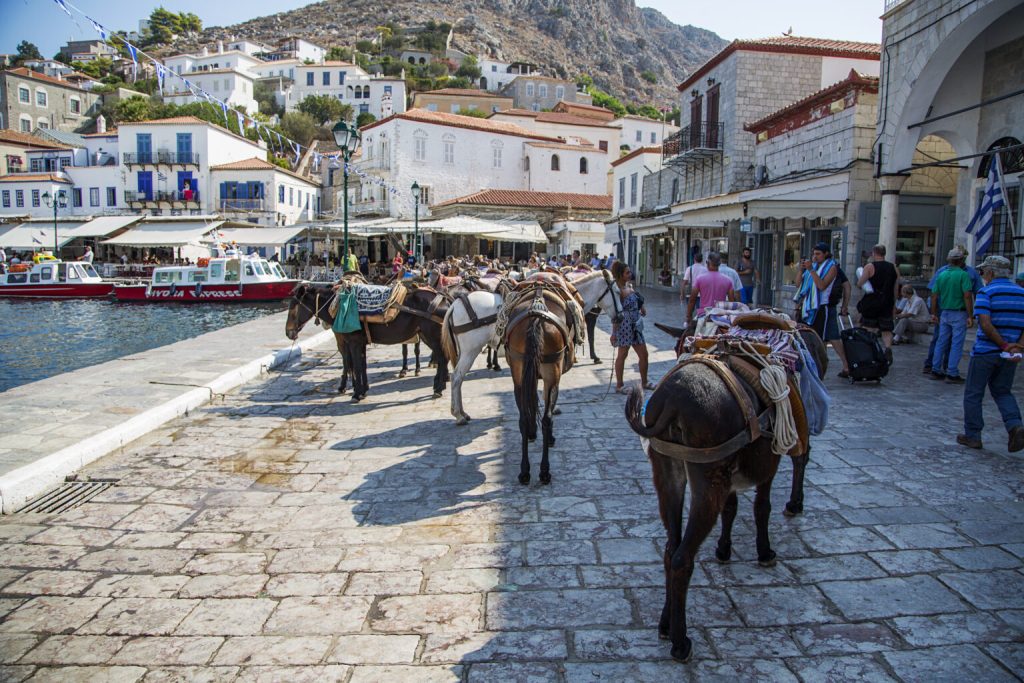
Hydra gently strips away the noise of city life and replaces it with a slower, more graceful rhythm. From the moment you approach its shores, the island feels like a step into another era—calmer, quieter, and deeply atmospheric.
From Piraeus to Hydra: A Journey Through Time
The short sea journey from Piraeus to Hydra feels less like travel and more like transition. As the island comes into view, its amphitheatrically built town reveals itself like a stone jewel rising from the sea.
The absence of cars is immediate and striking. Instead, movement belongs to walking paths, donkeys, and the sea. You wander along the harbor and into narrow alleys, small squares, and hillside neighborhoods like Kiafa, discovering the island step by step.
Life here unfolds in simple gestures—greetings exchanged with strangers, open windows revealing glimpses of historic mansions, and the quiet presence of a place shaped by centuries of maritime prosperity.
A Town Built on Maritime Heritage
Hydra’s elegance is rooted in its history. During the late 18th and early 19th centuries, the island flourished through its powerful merchant fleet. Wealth from Mediterranean trade returned in the form of grand architecture and refined interiors.
Today, the town still reflects that era: stately mansions and captains’ houses built from local stone, with tiled roofs, wooden details, and colorful doors framed in white. While the exteriors remain modest, the interiors once held—and in some cases still hold—rich decoration, frescoed ceilings, marble floors, imported furnishings, and ornate objects brought from across the Mediterranean.
These homes speak quietly of a time when Hydra’s captains returned not only with wealth, but with culture, ideas, and influence from distant ports.
Stories Along the Harbor
The harbor of Hydra is more than a postcard view—it is a living archive of stories. Over the decades, it has drawn artists, writers, musicians, and global figures, earning a reputation as a discreet yet magnetic cultural refuge.
Its cinematic beauty became widely known in the 1950s, and in the decades that followed it attracted a cosmopolitan crowd that included international celebrities, intellectuals, and artists. Writers and poets, painters and musicians found inspiration in its simplicity and silence.
Yet Hydra’s creative identity goes deeper than fame. It is also the birthplace and home of important Greek poets and artists, and a long-standing meeting point for literary and artistic minds.
Today, that cosmopolitan spirit continues in a quieter form—through cultural events, exhibitions, weddings, and seasonal gatherings that animate the harbor without overwhelming it.
A Quieter Season
Outside the summer months, Hydra reveals a different character. In the calm of autumn and winter, the harbor slows down. Cafés remain open for lingering conversations, locals gather by the waterfront, and the island breathes at an unhurried pace.
There is space to notice details: the sound of footsteps on stone, the changing light on neoclassical façades, and the stillness of boats resting in the port.
Museums and Landmarks of the Harbor
At the edge of the harbor stands the statue of Admiral Andreas Miaoulis, a key figure in Greek naval history. Nearby, historic buildings that once served practical maritime purposes now house cultural institutions and public services, preserving their architectural character while adapting to modern life.
The Historical Archive–Museum of Hydra preserves a rich collection of artifacts, paintings, maps, naval instruments, costumes, and historical documents that trace the island’s role in maritime trade and the Greek War of Independence.
At the center of the harbor stands the island’s main church, the Cathedral of the Dormition of the Virgin Mary, a place defined by its ornate interior and historic craftsmanship.
Nearby, the former mansion of Pavlos Kountouriotis—now a museum—offers a glimpse into the life of one of Greece’s most prominent naval figures and political leaders.
Toward Kaminia and Kiafa
Walking beyond the main harbor, the landscape becomes quieter. The small settlement of Kaminia reveals a more residential side of the island, with traditional houses and restored villas. Historic buildings here reflect Hydra’s long connection to seafaring families and cinematic history.
Further uphill lies Kiafa, the island’s oldest settlement. Its narrow, winding alleys form a maze of stone paths, small workshops, and quiet churches perched above the sea. From here, the views open widely over the harbor and the surrounding Aegean.
The Essence of Hydra
As the day comes to an end and the ferry approaches, Hydra feels unchanged by time and carefully protected from it. The absence of modern distractions is not a limitation but a defining quality.
What remains is a rare sense of continuity—an island where architecture, history, and daily life exist in quiet balance. Leaving Hydra feels less like departure and more like stepping out of a different rhythm, one that stays with you long after the sea fades from view.
Content Manager: Ambassador Mykonos Promo Kostas Skagias

